Wilfred Owen and Scarborough
Of all the First World War poets, Wilfred Owen is perhaps the best-known.
He wrote some of his poems at what is now the Clifton Hotel, overlooking Scarborough’s North Bay, where there is a prominent blue plaque to ‘mark the spot’.

This blog post will focus on elements of Owen’s time in Scarborough.
Stationed at Scarborough
Owen was stationed in Scarborough several times during the First World War.
His time here also included spells at the Victoria Hotel in the town, and at the Northern Cavalry Barracks, Burniston.

In October 1917, Owen joined the 5th (Reserve) battalion of his regiment, the Manchesters, in Scarborough.
The NCOs and men were stationed at the barracks, close to nearby Burniston.
The officers were quartered in the Clarence Gardens Hotel, now called the Clifton Hotel.
Owen’s room was a turret room with five windows, a coal fire and stunning views. He was in charge of the hotel’s domestic arrangements:
“I have to control the Household, which consists of some dozen Batmen, 4 Mess Orderlies, 4 Buglers, the Cook … two female kitcheners, and various charwomen! They need driving. You should see me scooting the buglers round the dining-room on their knees with dustpan and brush!’ … ‘Life here is a mixture of wind, sand, crumbs on carpets, telephones, signatures, clean sheets, shortage of meat, and too many moneysums. But I like it’.
From December life in Scarborough began to appeal to Owen, and he explored the town at length:
‘So I sit in the middle of my fivewindowed turret, and look down upon the sea. The sun is valiant in its old age.’ When he had time, he enjoyed looking for antique furniture in the town. He also visited a couple of bookshops in the town.
The Miners
A mining disaster in January 1918 gave Owen the starting point to write ‘Miners’ written while he sat beside his coal fire at the hotel and it was published in The Nation in January 1918.
Wilfred was then stationed at Ripon in March and returned to Scarborough in June, this time at the barracks.
In Owen’s own words: “I live in a tent with a cinder floor … It is inundated with vile dust … We get up at six, work furiously till 6pm, after which we are too tired to move … here one does not live at all, One eats (badly), sleeps (well) and works like a demented piece of clockwork.”
The Spanish Flu
During his posting to the barracks, something else also started to emerge.
As well as the devastating impact of the First World War, an invisible virus was going to change so many lives … the so-called Spanish Flu.
He wrote letters about the illness, which would sweep the globe and leave over 50million dead.
In a letter to his mother Susan Owen, he penned:
‘STAND BACK FROM THE PAGE! and disinfect yourself’ Quite one third of the Batt and about 30 officers are smitten with the Spanish Flu. The hospital overflowed on Friday, then the Gymnasium was filled, and now all the place seems carpeted with huddled blanketed forms…. The boys are dropping on parade like flies in number.’
Owen’s letter has a slightly humorous tone, presumably in part to prevent his mother worrying about him, yet by December of that same year, the press was printing articles along the lines of:
‘Never since the Black Death has such a plague swept over the face of the world … never, perhaps, has a plague been more stoically accepted’. The Times in December 1918.
It is understandable that, given his trench warfare experiences and the serious diseases that soldiers often suffered, the Spanish Flu was somewhat downplayed in his letters, yet reading between the lines, we can, post Covid, sense that Owen was concerned for his fellow soldiers and officers.
Death of Owen
Owen remained in Scarborough until August 1918, and was later posted back to France where he was sadly killed shortly before the armistice in November 1918.
Burniston Barracks was decommissioned in 1992 and demolished the following year.
The Clifton Hotel is still a popular hotel, and has one of the finest positions overlooking the North Bay.
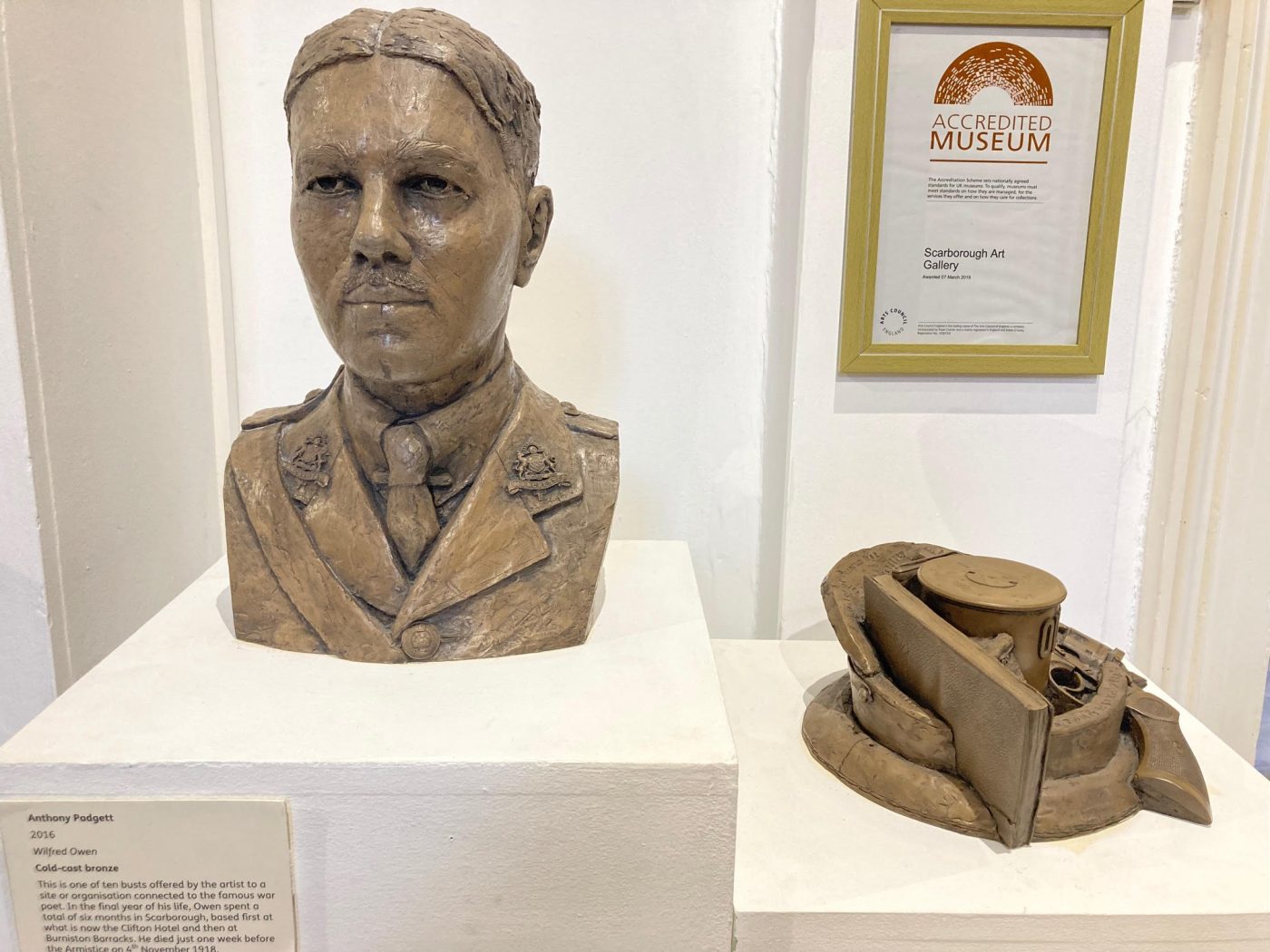
The Art Gallery in Scarborough features some Wilfred Owen exhibits.

Sources
https://shura.shu.ac.uk/29467/3/Mundye-WilfredOwenScarborough%28AM%29.pdf
Wilfred Owen – A New Biography – Dominic Hibberd
Regulating the Spanish Flu
https://pmc.ncbi.nlm.nih.gov/articles/PMC3867839
https://www.greatwarforum.org/topic/73161-burniston-barracks-scarborough

